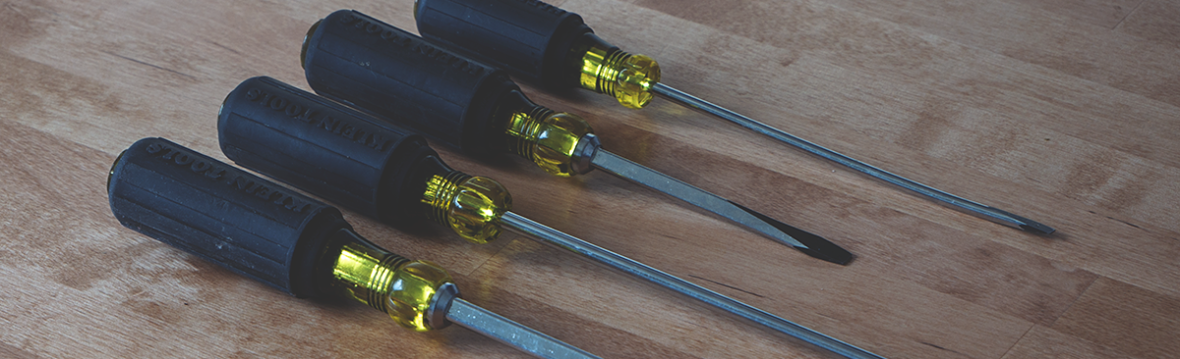
A flat-head screwdriver has a wedge-shaped flat tip for tightening or loosening screws having a straight, linear notch in their heads.
The ubiquitous flat-head screwdriver is possibly the most popular tool on the planet. One or two can be found in any junk drawer. While it takes different forms, the concept remains the same. A handle will be fitted to a steel shaft that has been flattened into a wedge form at the tip. This flat tip is precisely proportioned to fit into a screw with a correspondingly shaped straight head slot. Screws with different-sized slots on their heads require different screwdriver sizes.
The Screwdriver’s History
This tool is so old that it was first mentioned in history in the 1500s. The flat-head screwdriver set, in its contemporary form, was presumably devised in 1744 in England, where it was known as a “turn-screw”—a type of bit used as an attachment in a carpenter’s brace-and-bit tool. The hand-held version initially debuted in the United States in the 1800s, and for the following 130 years or so, the flat-head was the only form of the tool available until the Phillips head, based on a patent by Henry F. Phillips, was introduced.
A Tool with a Wide Range of Applications
While not the ideal screw design, the flat-head was the first, and as a result, a flat-head screwdriver is required to remove or install a plethora of items. Even while screw types like Phillips heads, square-drive heads, pozi-drive heads, and Torx-type heads have mostly supplanted the flat-head screwdriver, you’ll occasionally need to use one.
The flat-head screwdriver is one of the most readily found tools (or perhaps because of this), but it’s also one of the most mistreated. When other tools aren’t available, it’s frequently used in their place. A flat-head screwdriver can be used as a chisel, a nail puller, a paint scraper, an awl, or a small pry-bar by clever (or sometimes just impatient) handymen and handywomen. Experienced DIYers know that an old flat-head screwdriver should never be thrown away since it may be ground down, bent, filed, or otherwise modified to a variety of useful uses around the house.
However, you must exercise caution when departing from the tool’s comfort zone. If you pry too hard, the tool’s end will shatter off, leaving you with little more than a fishing weight in your toolbox. Using it as a chisel and beating on the end with a mallet can also break the handle. A flat-head screwdriver with a broken handle is extremely inconvenient. That may be the only time you’ll need to dispose of it.
How to Use a Screwdriver Correctly
Flat-head screwdrivers come in a variety of sizes, so choose the one in your toolbox that best fits the work at hand—that is, the one whose blade fits the screw slot the best. As the size of the screw rises, the slots in flat-head screws require not only a wider tip, but also a thicker tip. Flat-head screwdrivers have varying thicknesses according to their breadth, which should provide great grip in a screw slot. The main disadvantage of a flat-head screwdriver is that it is prone to slide out of the screw slot, so finding one that fits perfectly is essential for proper use. There should be very little wiggle area between the blade and the slot on the screw. This is simply one of several low-cost tools you should keep in your toolkit.
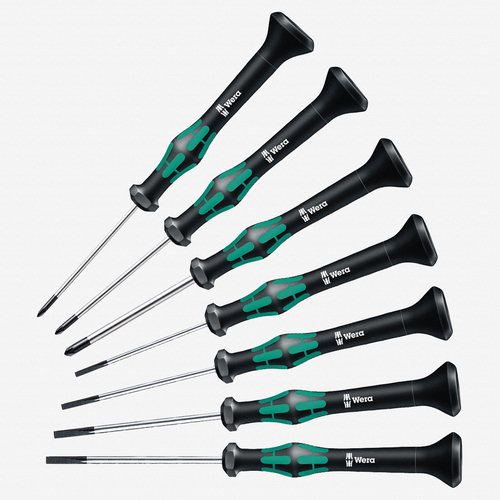
 New Precision Sets